Background
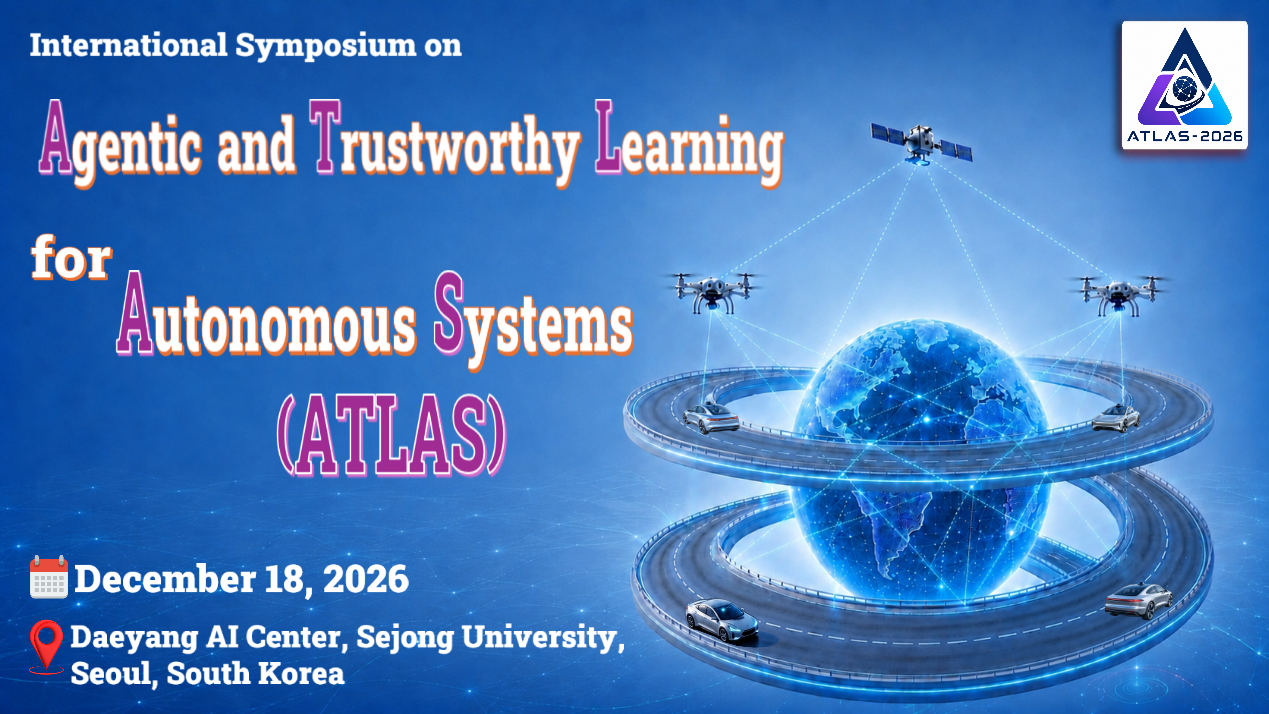
AI is shifting from conventional predictive modeling toward autonomous agents that perceive, reason, learn, plan, and act in dynamic environments. Advances in agentic AI, foundation models, multimodal learning, RL, and embodied intelligence are reshaping autonomous vehicles, robotics, drones, intelligent transportation, cyber-physical systems, and smart infrastructure. What distinguishes these agents from static models is that they must respond to changing conditions, coordinate with humans and other agents, and make consequential decisions under uncertainty and incomplete information. This growing autonomy sharpens concerns about safety, reliability, robustness, security, privacy, explainability, accountability, and human oversight. Agentic and trustworthy learning responds by coupling advanced learning and decision-making with risk awareness, verification, interpretability, secure operation, and alignment with human values. Progress in this area is central to building AI agents dependable enough for real-world and safety critical deployment.
Goal/Rationale
The goal of ATLAS Symposium is to advance agentic and trustworthy learning as a coherent research agenda for autonomous systems, and to narrow the gap between foundational learning methods and their dependable deployment in the field. The rationale is twofold. First, progress in agentic AI, foundation models, and reinforcement, continual, and federated learning is outpacing the methods needed to make such systems safe, verifiable, and accountable, so capability is advancing faster than trust. Second, the relevant expertise remains scattered across machine learning, robotics, communications, control, and cybersecurity, and the open problems are seldom examined together. A dedicated symposium brings these communities into one venue to develop shared benchmarks, evaluation practices, and design principles. Concrete settings such as connected and autonomous vehicles, where trustworthy, adaptive, and communication efficient decision-making must hold under high mobility, uncertainty, and strict latency and privacy constraints, illustrate why integrated approaches are needed rather than isolated advances. By convening researchers, practitioners, and students at all career stages, ATLAS Symposium seeks to catalyze new collaborations and to move agentic learning toward reliable, real-world autonomy.
Scope
ATLAS Symposium invites theoretical, methodological, and applied contributions across agentic and trustworthy learning for autonomous systems, and welcomes work at any stage of maturity. On the methods side, relevant topics include agentic AI and autonomous multi-agent decision-making; foundation models and generative AI for autonomous applications; reinforcement, continual, self-supervised, and federated learning; multimodal perception, reasoning, and planning; embodied intelligence; human-agent collaboration; and distributed edge intelligence. Trustworthiness themes span safety assurance and verification, reliability, explainability, uncertainty quantification, risk aware learning, adversarial robustness, privacy, cybersecurity, accountability, and alignment with human values. Application domains include autonomous vehicles and intelligent transportation, robots and drones, IoT platforms, cyber-physical systems, smart infrastructure, and 6G-enabled services. Participants are further encouraged to address resource-efficient deployment, communication-efficient federation, digital twins, evaluation frameworks, datasets, simulation environments and testbeds, standards, governance, and the ethical and societal implications of increasingly autonomous AI.